
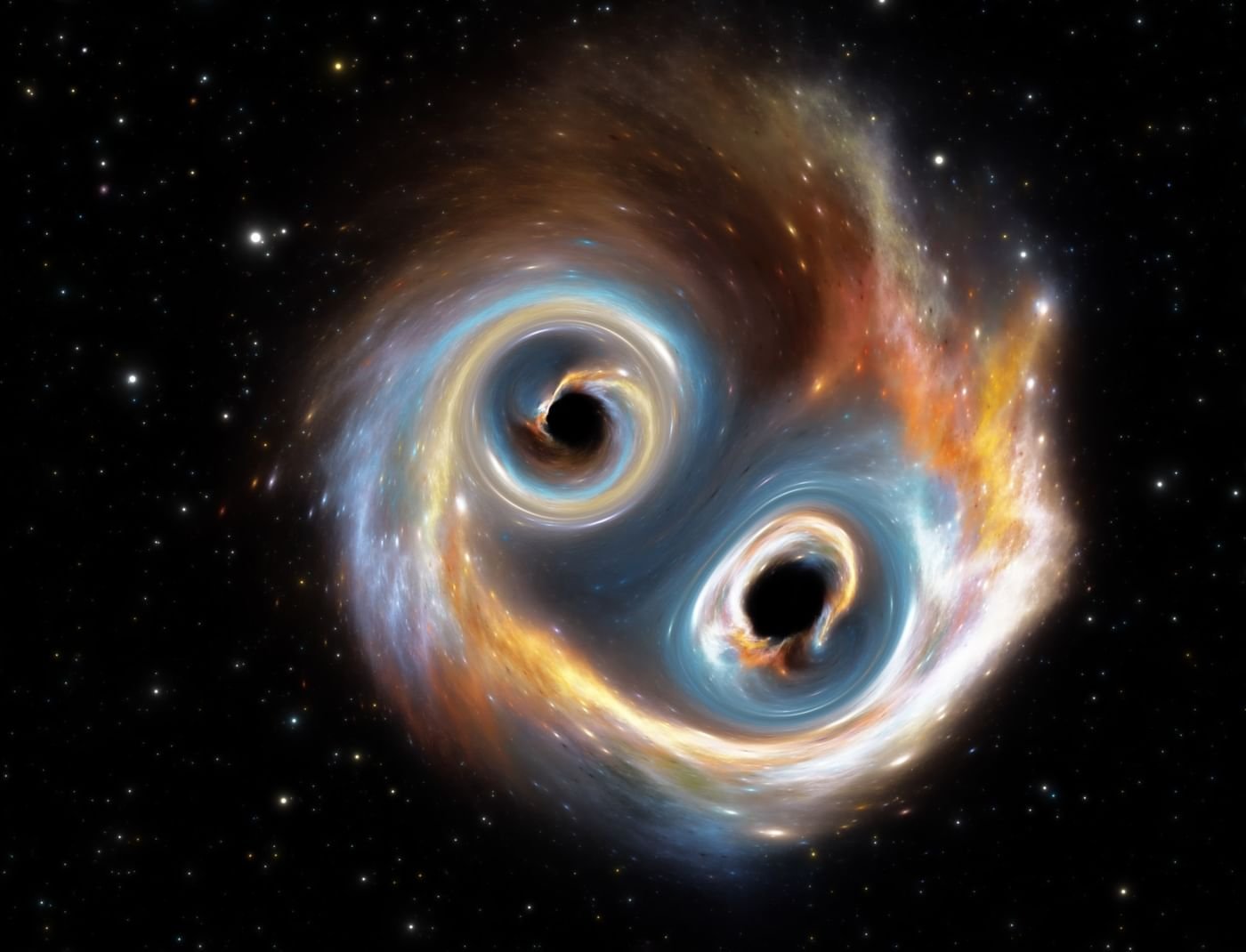
In a groundbreaking astronomical achievement, scientists have successfully captured the first-ever radio image showing two supermassive black holes orbiting one another within a distant quasar known as OJ 287.
The image, unveiled by an international team of researchers, shows a remarkable cosmic pairing—two enormous black holes bound together in orbit—residing in the luminous quasar OJ287, located roughly 5 billion light-years from Earth in the constellation Cancer. Quasars are intensely bright regions found at the centers of galaxies, powered by supermassive black holes whose immense gravitational forces heat surrounding gas and dust until they emit dazzling light.
Researchers explained that this discovery provides the most definitive visual confirmation so far that binary black holes—two gravitational giants locked together—do indeed exist in the universe.
“Quasar OJ287 shines so brightly that even private telescopes used by amateur astronomers can spot it,” said Mauri Valtonen, lead author of the study and astronomer at the University of Turku, Finland, in a statement shared with Xpats.ae.
Although scientists had previously imaged single black holes, including those at the centers of the Milky Way and Messier 87 galaxies, this is the first instance where two black holes have been observed circling each other. Earlier detections of gravitational waves hinted at binary systems like this, but the black holes in OJ 287 could not be visually resolved before, as existing telescopes lacked the necessary precision.
This major breakthrough was achieved by combining data from ground-based radio telescopes with observations from the RadioAstron (Spektr-R) satellite, whose orbit extends halfway to the Moon. This setup allowed astronomers to achieve an image resolution nearly 100,000 times sharper than standard optical telescopes.
Upon comparing the new radio image to theoretical models, “the two black holes were precisely where we predicted,” Valtonen confirmed. He noted that although black holes themselves remain invisible, their presence is revealed through the jets of energetic particles and luminous gas surrounding them.
The observation also captured a fascinating detail—the smaller black hole emits a jet that appears twisted “like the spray from a spinning garden hose,” an effect caused by its rapid movement around the larger one. According to researchers, this jet will oscillate like a tail as the smaller black hole continues its 12-year orbit, offering a rare opportunity for astronomers to view such orbital motion in real time.
The full study has been published in the Astrophysical Journal, marking a milestone in the visual study of binary black holes.